
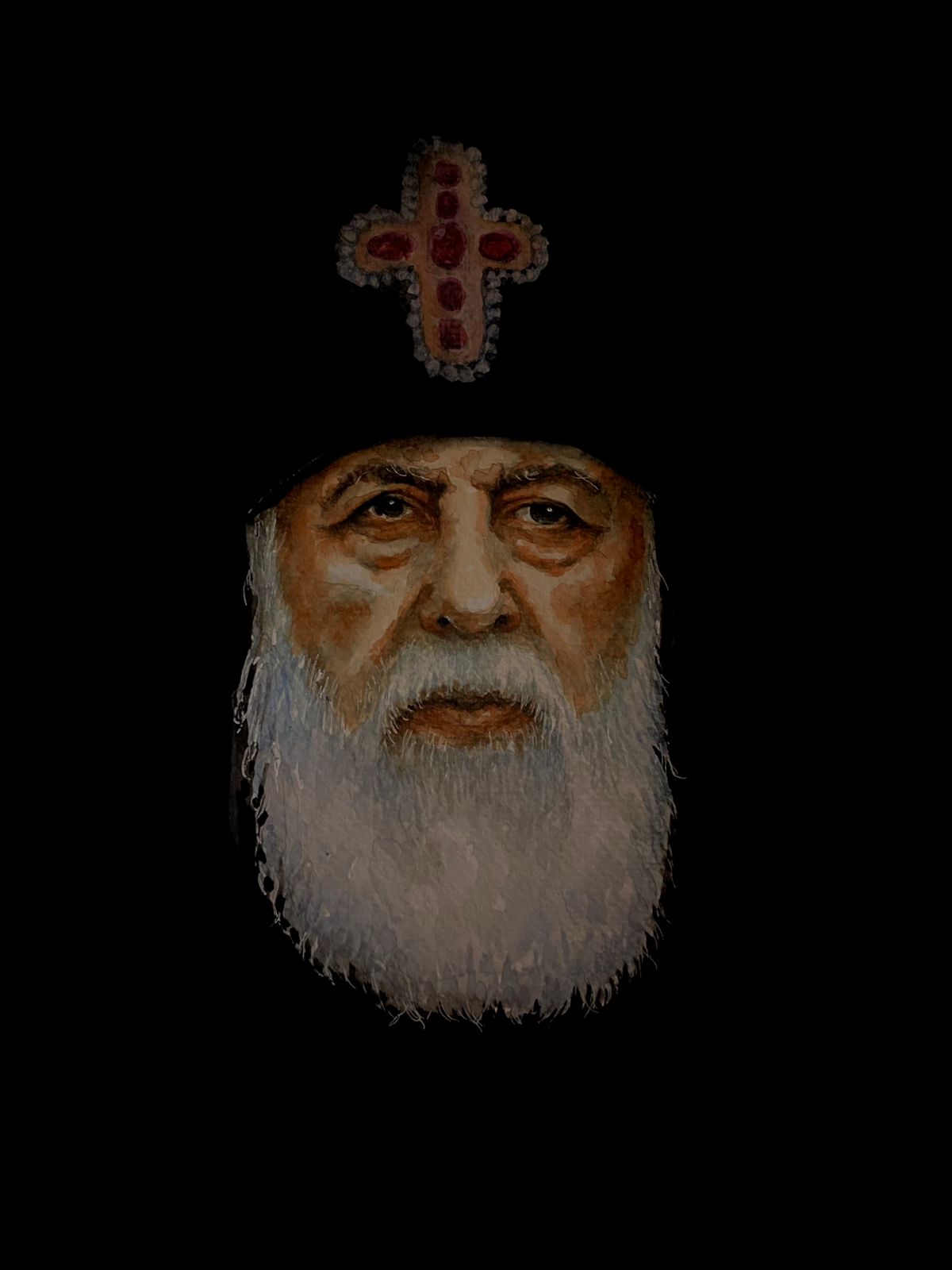
 Catholicos-Patriarch Ilia II — watercolor by Bishop Rusudan Gotziridze
A Crown of Laurel and Shadow
By Malkhaz Songulashvili
In the early 1970s my father, Lado Songulashvili, was appointed to preach to the Georgian-speaking faithful at the Baptist church in Sukhumi on the Black Sea. The Sukhumi congregation had been thoroughly Russified during the Soviet Era. The church’s pastor, the Rev’d Akaki Narsaidze, was ethnically Georgian but could not speak Georgian, having been completely Russified. My father’s posting to Sukhumi was, in many respects, an anti-imperial and anti-colonial initiative, strongly supported by the Revd Giorgi Bolgashvili, who had often reproached Narsaidze for his inability to preach in Georgian.
From time to time, I accompanied my father to Sukhumi. The Georgian-speaking community there was very small; those who attended my father’s services also worshipped at a Georgian Orthodox parish in the same city. It was there that I first heard of Bishop Ilia of Sukhumi, who was greatly admired by both my father and his Georgian parishioners, although hardly anyone knew him then in Georgia or elsewhere. Some years later, when I was in my mid-teens, Bishop Ilia was elected Catholicos-Patriarch of All Georgia.
Our Baptist church—now the Peace Cathedral—received six invitations to attend the Patriarch’s enthronement at Svetitskhoveli Cathedral, founded in the early fourth century and regarded as the first Christian church in Georgia. The enthronement was scheduled for 25 December, the day we celebrate Christmas at the cathedral. My father was to preside over the Christmas liturgy and therefore could not attend the enthronement. That is how I came to receive a ticket. As I did not own a decent coat, I borrowed one from my older brother Giorgi, who rather reluctantly lent me his white leather coat, which I believe had been made in Germany.
My father drove me early to the old capital, Mtskheta, so that he could return to Tbilisi in time for the liturgy. It was a very cold morning; I could feel the crisp air filling my lungs. The bells were ringing and the atmosphere was both solemn and uplifting.
As I approached the entrance to Svetitskhoveli, a black Chaika—a prestigious Soviet car—arrived, and a clergyman dressed in white emerged: Patriarch Pimen of Russia. The cathedral was full an hour before the enthronement. A long red carpet ran down the center, adorned with laurel branches. I made my way closer to the iconostasis, eventually standing to its left. Over the next hour many clergy arrived; all vested in their ceremonial garments. At last, the Patriarch-elect entered; everyone strained to catch a glimpse of him. The liturgy was long but profoundly beautiful.
The Patriarch was enthroned by several Georgian bishops—Keratishvili, Ananiashvili, Petriashvili and Ghonghadze—with the assistance of other clergy, led by Igumen Anton Guliashvili.
At the end of the enthronement the newly enthroned Patriarch delivered his first address. I noticed leaders of the Baptist Church standing near the grave of King Erekle II on the opposite side of the nave. I made my way over to them and, with their help, entered the sanctuary. There I saw Vazgen I of Armenia, Patriarch Pimen and other guests, including Ian Snezhinski of the Roman Catholic Church in Tbilisi.
It was a deeply moving and unforgettable day. To this day, I keep the invitation ticket and a laurel branch that I brought home as a souvenir. I returned to Tbilisi with the Baptist clergy, who dropped me off before proceeding to the banquet celebrating the enthronement with the other guests. They thought I was too young to attend such a party. I don’t think I agreed with them, but I did not insist. I suppose I am one of the very few people left who attended that enthronement; I do not believe any of the present Georgian Orthodox bishops were there.
Years passed. I entered university and studied Greek, Latin and Hebrew. I was 23 when Catholicos Ilia II invited me to join the Georgian Bible translation commission he had established. He was the first hierarch of the Georgian Orthodox Church to commission a translation of the Bible into modern Georgian. I could hardly believe it was happening! I had been invited to join a group of eminent translators and scholars, among them Zurab Kiknadze, Bachana Bregvadze, Nisan Babalikashvili and Jemal Ajiashvili—names known to every educated Georgian.